Wednesday, 7 March 2018

Ramses II

Finally I decided to end my time travel journey, but not before seeing one of the most renowned pharaohs to ever walk the Earth, Ramses the Great. He ruled 60 years after Tutankhamun, starting in 1279 BCE and ruling for an astounding 67 years. During the start of his rule, the Egyptian empire was in its twilight years and in a state of disrepair, but was transformed into what is known as the golden years of Egypt. Ramses II, constructed more buildings & colossal statues than any other Egyptian kings including building two huge temples at Abu Simbel. Ramses II was also a fearsome military leader, with many military campaigns against enemies, and expansion of the Egyptian empire. His most famous battle, was the Battle of Kadesh, fought with the Hittites resulting in the signing of the first peace treaty. He also had a statue built in the Valley of Kings where his body resided once he died. Not long after his rule, Egypt was invaded and crumbled, falling under the rule of foreigners: Nubians, Assyrians, Persians, Greeks, and Romans. During his rule, Ramses enriched many of the characteristics of civilizations through advancements in politics, technology, warfare, and trade, making him arguably the greatest Egyptian king.
Image result for battle of kadesh ramses ii
Ramses in the Battle of Kadesh
http://www.greatdreams.com/blog-2014-2/ramses-ii-battle-of-kadesh.jpg
Image result for ramses ii
Statues at Abu Simbel
http://www.ancient-origins.net/sites/default/files/abu-simbel-ramses-ii.jpg

Tutankhamun

Now fulfilled with the view of how the middle lived, I sought to see the rule of the son of Akhenaton, the famous pharaoh Tutankhamun. He ruled around during the end of the 1300's and was son of Akhenaton & minor wife, and was originally named Tutankhaton. I saw during his reign the collapse of the religion that his father had worked so hard to create. He restored priests and moved the capital back to Thebes, but since he was so young I believe that he might have been a puppet. He died from an apparent head injury at 18 and had no completed tomb at the time, so he used the tomb of a noble instead. This may have been the reason for such a late discovery in 1922 by Howard Carter who was shocked to find unsurpassed treasures and the mummy of a young pharaoh. He is remembered now as the pharaoh who restored traditional Egyptian religion, thereby playing a part in the characteristics of civilizations by reversing a religious revolution.
Image result for tutankhamun
Sarcophagus of King Tut
https://cdn.history.com/sites/2/2015/04/hith-hippo-king-tut-E.jpeg
Image result for tutankhamun
 Interior of King Tut's Tomb
https://newsofthenewage.files.wordpress.com/2017/03/
tutankhamun-tomb.jpg?w=672&h=372&crop=1


Nebamun

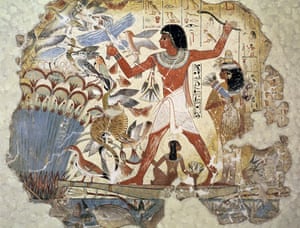
After seeing all the antics of the many famous pharaohs, I decided to see how some of the more ordinary individuals lived. This lead me to Nebamun, a scribe and grain accountant who lived during 1350 BCE. He worked at the large temple complex near Thebes and was considerably important due to his affiliations with the temple and grain supplies. The reason I took particular interest in Nebamun was because of “The Tomb of  Nebamun.” Found on the west bank of the Nile, it is viewed as being quite important due to the vast amount of riches found along with multiple “paintings,” especially the ones found in 1820, now displayed in the British Museum. This was a surprising fact as he himself was not a member of the royal family. His role in Egypt helps to highlight an important facet of civilizations, specifically merchants and trade, and their need in the complex society of Egypt.
Image result for nebamun
Hunting in the Marshes
https://i.guim.co.uk/img/static/sys-images/Guardian/Pix/pictures/2009
/1/3/1230996512027/Nebamun-Hunting-Fowl-Brit-001.jpg?w=300&
q=55&auto=format&usm=12&fit=max&s=
2c0e342e434dd74bb4582c7baee15dc9
Image result for nebamun
Pond in a Garden
https://upload.wikimedia.org/wikipedia/commons/thumb/4/4b/
Le_Jardin_de_N%C3%A9bamoun.jpg/1200px-Le_Jardin_de_N%C3%A9bamoun.jpg

Akhenaton

Travelling further ahead in time, I decided to visit another highly influential pharaoh, Akhenaton. He ruled from 1353-1336 BC in the 18th dynasty and was one of the most famous pharaoh's, sparking my interest. I learned that he was once named Amonhotep IV, then changed his name to Akhenaton meaning “He who serves Aton.” I witnessed him attempt a religious revolution, opposing the worship of Amon-Ra (the traditional supreme god) and instead sponsoring worship of god Aton, the sun-disk. I saw him build a new capital city, Akhetaton meaning “Place of the glory of Aton.” He confiscated the possessions of the other temples at Akhetaton and left all the traditional roles of a pharaoh to reside at his new capital. I noted that he was quite motivated by his wife Nefertiti who also sponsored this change, sadly starting the long decline of the Egyptian civilization. Akhenaton was a key figure in the religion of Egypt attempting to change the most famous patron god and start a religious revolution. This change had great impacts due to the nature of religion when it comes to characteristics of civilization.
Image result for akhenaton
Bust of Akhenaton
http://www.azquotes.com/public/pictures/authors/95/
1a/951a5a2861a0cab45731512401ccb366/53b11daa03057_akhenaton.jpg
Image result for aton sun god
Worship of Aton
http://www.ancientegyptonline.co.uk/
images/aten2.jpg

Thutmosis III

Later, I decided to travel and view the rule of Hatshepsut's son, the one who she served as regent for and who eventually deposed her. He ruled after 15 years of Hatshepsut’s, assuming power in his mid to late 20’s. Before he became pharaoh he trained in the military and became a successful general, engaging in numerous military campaigns. He was known as the “Napoleon of Egypt” due to these successful military campaigns, with more than 17 occurring. This lead to the largest empire Egypt had seen until that point. I witnessed his magnificent rule of nearly 54 years and was stunned. This is what makes an empire great, such great military might, a factor that is characteristic of civilizations.
Image result for thutmosis
Statue of Thutmosis III
https://upload.wikimedia.org/wikipedia/commons/thumb/b/bc/
TuthmosisIII-2.JPG/1200px-TuthmosisIII-2.JPG
Image result for thutmose iii
Mummified head of Thutmosis III
https://upload.wikimedia.org/wikipedia/commons/thumb/e/ee/
Thutmose_III_Head.jpg/250px-Thutmose_III_Head.jpg

Queen Hatshepsut

During my travels back in time to New Egypt, I encountered an individual who is believed to have been the first powerful female Eqyptian leader. Queen Hatshepsut ruled around 1470 BCE after her husband, Tuthmosis II, passed away. She became regent for her son and declared herself as a female king with a reign of peace, stability, and prosperity. She expanded trade to Punt (Modern day Somalia), built herself a massive tomb named Deir Al Bahari, and built obelisks at the great temple of Karnak near Luxor. However what I found strange was that many images and depictions of her rule were removed when her son, Tuthmosis III, came to power leading to uncertainty regarding such a powerful Queen. Hatshepsut was very influential and successful in trade, a characteristic of civilizations, expanding Egypt's influence.
Statue of Queen Hatshepsut at the Met
https://upload.wikimedia.org/wikipedia/commons
/thumb/1/11/Hatshepsut.jpg/220px-Hatshepsut.jpg
Image result for deir el bahri
Picture of massive Deir Al-Bahari complex
http://www.ancientegyptonline.co.uk/images/deirelbahri.jpg